Impunity and Reenactment: Reflections on the 1965 Massacre in
Indonesia and its Legacy
Benedict R. Anderson
Domestic mass murder on a large scale is always the work of the
state, at the hands of its own soldiery, police and gangsters, and/or
ideological mobilization of allied civilian groups. The worst cases in the
post-World War 11 era – Guatemala, Sri Lanka, Cambodia,Sudan,Bosnia,Rwanda,
Liberia, China, East Pakistan, East Timor, and Indonesia – show much the same
bloody manipulations. It is equally the case that the killer regimes do not
announce publicly the huge numbers killed, and rarely boast about themassacres,
let alone the tortures that usually accompany them. They like to create a set
of public euphemismsendlesslycirculated through state-controlled mass media. In
the age of the UN, to which almost all nation-states belong,in the time of
Amnesty International and its uncountable NGO children and grandchildren, in
the epoch of globalization and the internet, there are naturally worries about
‘face,’ interventions, embargos, ostracism, and UN-ish investigations. No less
important are domestic considerations. National militaries are supposed
heroically to defend the nation against foreign enemies, not slaughter their
fellow-citizens. Police are supposed to uphold the law. Above all, there is
need for political ‘stability,’ one element ofwhich is that killing should not
get out of control, and that amateur civilian killers should be quietly assured
that ‘it’s over’ and that no one will be punished.
But every norm has its exceptions. In the article that follows
below, readers are invited to reflect on Joshua Oppenheimer’s two recent
sensational films about organized gangsters in and around the city of Medan (in
northeastern Sumatra) who played a key, but only local, role in the vast
anti-Communist murders in Indonesia in the last months of 1965. Almost fifty years
later, they happily boast about their killings, with the grimmest details, and
relish their complete immunity from any punishment. They are also happy to
collaborate with Oppenheimer, contribute to his films, create bizarre
reenactments of 1965,and do not hesitate to dress up their underlings to act as
communists (male and female). The problem is to explain why Medan was the scene
of the exception, within the larger framework of Indonesian politics from the
late colonial period to the present.
The final irony is that Joshua’s (and the gangster’s) film is
banned in Indonesia – that is to say, by Jakarta.[1]
[1]It is worth mentioning that in the early years
after Suharto’s fall from power in 1998 (remembered as the time of Reform)
censorship of publications almost disappeared. Long-forbidden works by dead
communists – going back as far as the 1920s – were resurrected. Accounts by
communist survivors of their suffering inSuharto’s gulag circulated without
being banned. A flood of conflicting analyses of ‘what really happened in 1965’
sold well, especially if they claimed that the secret masterminds of the
Gerakan 30 September were Suharto, the CIA, or MI-5.
It seems that the post-Suharto authorities assumed that the masses
were not readers, and the distribution of the books by the market would depend
on the character of regional readers (say, plenty in Java, very few in Medan).
TV and the cinema were another story since they appealed to large non-reading
publics. Controversial films could arouse old and new hatreds and seriously
threaten ‘stability.’ Typically, the notorious Suharto-era film about G30S,
year after year forced on schoolchildren, was now silently taken out of
circulation.
***
There is a jolting moment in Jean Rouch’s famous ‘anthropological’
film Moi, Un Noir, about a small, attractive group of young
males from then French colonial Niger trying to find work in the more
prosperous, but still French colonial, Côte d’Ivoire. We see them periodically
at work, but most of the film shows them at leisure, drinking, joking, hooking
up with women, so that the atmosphere is generally lively and cheerful. But
toward the end, we find the main character, who calls himself Edward G.
Robinson (parallel to a friend who names himself Lenny Caution), walking with a
sidekick and an invisible Rouch along a riverside levee. Quite suddenly he
starts to re-enact for the camera an ugly scene from his real or imagined past.
He was among the many francophone Africans who were sent as colonial cannon
fodder to fight for France against the Ho Chi Minh-led Viet Minh – before the
fall of Dien Bien Phu. He seems to enjoy replaying his bloody killing of
captured Vietnamese. His sidekick pays no attention, making us realize that he
has seen this shtick many times and knows it by heart. So the brief show is
meant for Rouch and for us. Once the scene is over, and the cheerful tone
resumes, the viewer is immediately assaulted by the obvious doubts and
questions. Why did Rouch include this short scene in an otherwise friendly
film? Did Oumarou Ganda aka Edward G. Robinson, who was Rouch’s main
collaborator, insist upon it? Why did the African perform this way, quite suddenly?
Did he really do what he re-enacted? Why the sudden turn from jokes to horror –
and back? Did Rouch intend to situate the Niger boys of that generation in the
large framework of the ferocious decline and fall of France’s empire? Was Gonda
releasing a kind of frustration about his life, and resentment of the French,
perhaps even of his patron and friend, the famous Rouch?
When I watched the film, some years ago, it occurred to me that
the crucial motif to think about was simply impunity. Like everyone else
involved in France’s huge, disastrous military endeavour to recover colonial
Indochina between 1946 and 1954, the young African soldier could not be
punished for ‘acts of war,’ no matter how sadistic and in contravention of the
Geneva Convention. He would always be a hero of a very small sort thanks to
this impunity. At the same time, impunity is nothing without repetitive,
boastful demonstration to different audiences. Drifting, poor, irregularly
employed, Ganda takes on the menacing “Don’t mess with me, motherfucker!”
persona of Edward G. Robinson, the master actor of gangsters in the Hollywood
of that era – who usually dies at the end of each film, but comes back as
saturninely alive as ever in the next. But the film goes on to show the local
hollowness of the impunity. In French Côte d’Ivoire, the colonial authorities
put one of Ganda’s comrades into jail, and clearly would not hesitate to nab
the hero of Vietnam, if he broke the local laws. At the end he is beaten up by
a large drunken Portuguese sailor in a quarrel over a prostitute.
Always somewhere in the back of my mind, this episode tentatively
offers me a way to think about Rouch-fan Joshua Oppenheimer’s extraordinary
films about the massacres of communists in Indonesia in 1965-66, and their next-century
reenactment before the camera. One of these films – Sungai Ular or River of
Snakes – shows (to me at least) a connection between the situations of Rouch
and Joshua, as well as deep differences. The grisly re-enactment of the torture
and murder of doomed communists on the bank of this river, half a century after
they happened, is also about impunity and boastfulness. The two starring
elderly brutes take the young man from anti-comunist USA as more or less on
their side, just as Edward G. Robinson took Rouch as a sympathic anticolonial
Frenchman. But they also evince a kind of “Don’t mess with me, motherfucker!”
attitude which they regularly practice for various other local audiences. They
are not suspicious of Joshua’s motives, and Joshua gets his own immunity from
this guilelessness and also from inviting them and other killers to participate
as they wish in the filmwork, not merely as actors, but also as, up to a point,
film-makers. Another tie between the films is, as we shall see later on, the collaborators’
fascination with Hollywood. This time not Edward G. Robinson, outlaw, but Rambo
and the Duke, patriots.
Yet Joshua’s performing killers do not have their exact
counterparts – so I think – in other parts of Indonesia, for example, East and
Central Java, as well as Bali, provinces where the numbers of those barbarously
tortured and murdered were far higher than in North Sumatra where the
serpentine river flows. The question is why? In what immediately follows I will
try to offer a historical explanation that deals with the national-level and
official version of 1965 and its commemorative aftermath, and at the same time
contrast North Sumatra with East Java, which can be thought of a the most
striking opposites.
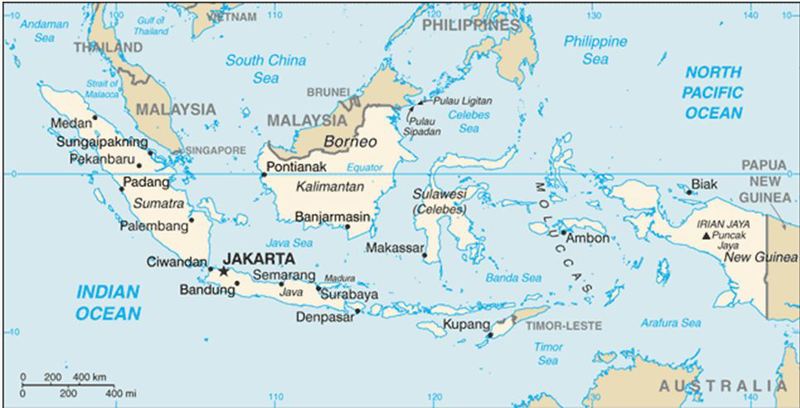
Source: CIA
|
October l, 1965
In the wee hours of that Jakarta morning, six important generals
were murdered by soldiers and NCOs belonging to President Sukarno’s elite
guards, the Tjakrabirawa Regiment. At 7 a.m. a military group calling itself
the September 30th Movement announced over the national radio that it had taken
action to forestall a coup to overthrow Sukarno four days later, on Armed
Forces Day. The deaths of the generals were not mentioned. A few hours later,
two key announcements followed. One declared that in place of the existing
cabinet, a large Revolutionary Council would temporarily take power for
protection of the president. Its membership was a weird mixture of left and rightwing
civilians and military men, but also included the leadership of the September
30th Movement: one general, one colonel, one lieutenant-colonel, and two or
three lower down. The second announcement was even stranger. The Movement said
that lower military ranks were enraged by the corruption and sexual license
within the military high command, which also neglected the poverty of the rank
and file. Therefore, all ranks above that of lieutenant-colonel were abolished,
while all supporters of the Movement would be promoted two ranks. A spectacular
– and stupid – mutiny, in effect, creating a crisis of solidarity among
clique-ridden generals and colonels. The Movement did not last long. After 3
p.m. it went off the air, to be replaced at 7 p.m. by proclamations in the name
of General Suharto, commander of the army’s elite Strategic Forces, who,
curiously enough, was not a target of the Movement. By midnight, the mutiny had
been crushed, and its leaders scattered and on the hopeless run. The capital’s
newspapers, except those of the military, were closed down the next morning,
and national TV, along with national radio, fell into Suharto’s hands.
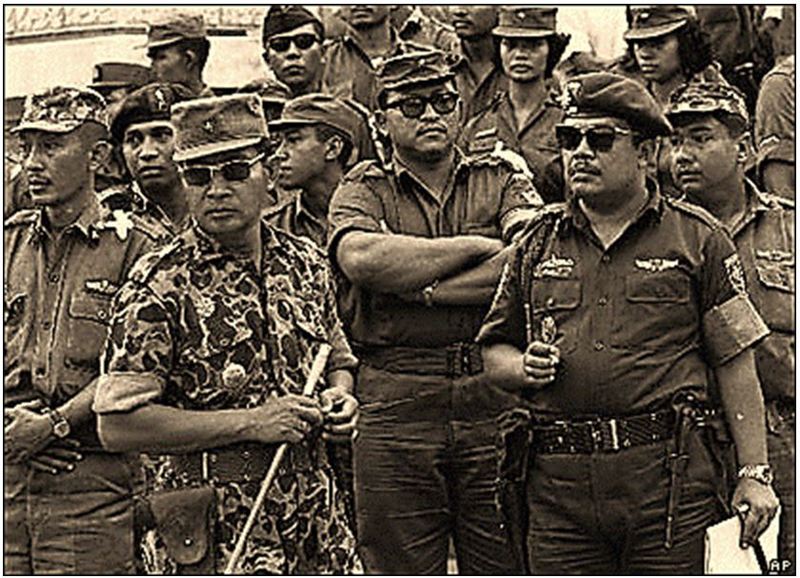
Gen. Suharto front left, 1965. New York Times
|
The Communists
The PKI (Indonesian Communist Party), Asia’s oldest, had made the
fateful decision – once Indonesian Independence had been recognized by the
Dutch colonialists and the rest of the world (near the end of 1949) – to take
the parliamentary road to power, shutting down a few small guerrilla bands left
over from the Revolution of 1945-49. In the first national elections (1955), it
was already the fourth of the four huge parties that dominated Parliament. When
provincial elections were held two years later in the densely populated and
impoverished island of Java, it secured the largest number of voters, but still
less than 25%. After that, elections were not held again. The primary reason
for this was the government’s decision, in the spring of 1957 to declare nation-wide
martial law in the face of warlordism, regional discontent, and rising,
fanatical anti-communism in the so-called Outer Islands, most significantly in
Sumatra and Sulawesi. The situation deteriorated till the point that in
February 1958 a civil war broke out between the now military- dominated
government in Jakarta and its Sumatran competition, the PRRI, or Revolutionary
Government of the Republic, led by a mixture of national-level ‘modernist’
Muslim politicians, regional warlords, and many of the local inhabitants. A
sister-rebellion in Sulawesi soon joined the Sumatrans. The rebellion, in spite
of being heavily supported by the CIA, was rather quickly crushed by mostly
Javanese troops loyal to the High Command, ironically with help from both the Pentagon
and Moscow. By the time President Sukarno repealed Martial Law in May 1963, the
army had entrenched itself in national power and refused to tolerate any
further nation-wide elections on grounds of ‘national security.’ But, protected
by Sukarno, who used it to counterbalance the dangerous anti-communist Army
leadership, the PKI rapidly expanded its popular support by putting its
energies into its mass organizations, rather than the parliamentary Party. By
early 1965, it was the largest communist party in the world outside the
Communist bloc, with over three million members, and perhaps eighteen million
followers in its mass organizations: for women, students, intellectuals,
peasants, agricultural labourers, workers, fisherfolk, youths, artists and so
on. (It was far better organized and disciplined than its political- party
competitors). The shift had momentous consequences. Electoral politics are
punctuated in time from this election to the next; but mass organization
politics are tensely ceaseless, day in day out, especially when no elections
are foreseeable.
In the early 1960s Indonesia became increasingly polarized between
right and left. A major factor was economic decline and an inflation that
eventually became beyond control. People on fixed salaries and pensions, mostly
civil servants, tried to maintain their standards of living by corruption,
embezzlement, and investing in farm land. This last not only put pressure on
land-hungry small farmers, tenants, and rural labourers, but clashed with the
PKI’s attempts to enforce a weak land reform law, fiercely resisted by
landowners old and new.
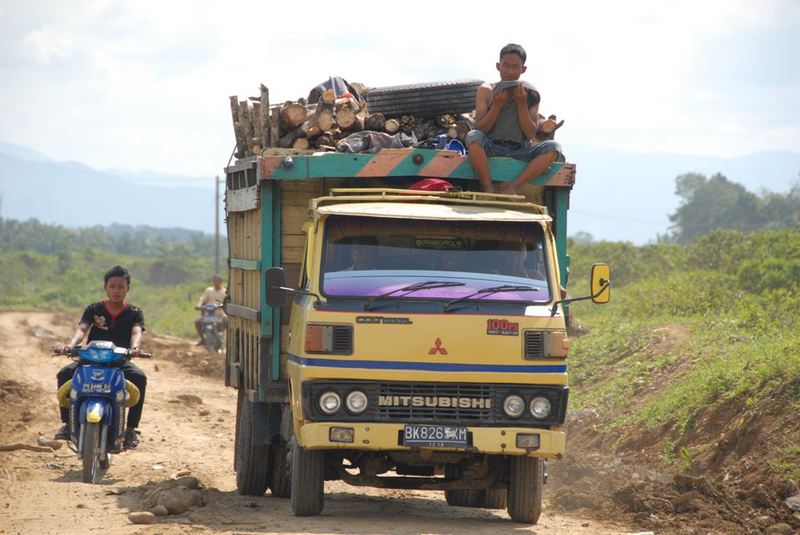
Rural Medan today
(Credit: Andre Vltchek)
|
Where such landowners were respected ulamas and rich hajis, resistance
was often couched in terms of religion versus atheism. Many of them shrewdly
donated surplus hectares to mosques as unalienable wakaf property,
and sat on the boards administering these gifts. Now religious, no longer
personal private properties they were difficult for the PKI to attack, since
even poor and land hungry Muslims would come militantly to their mosques’
defence. Generally speaking, the collapse of the currency helped to create a
pervasive atmosphere of fear, uncertainty and anger. These tendencies help to
explain why the largest and worst massacres took place in the country’s
villages, where land was most seriously contested and the big-party mass
organizations were most active.
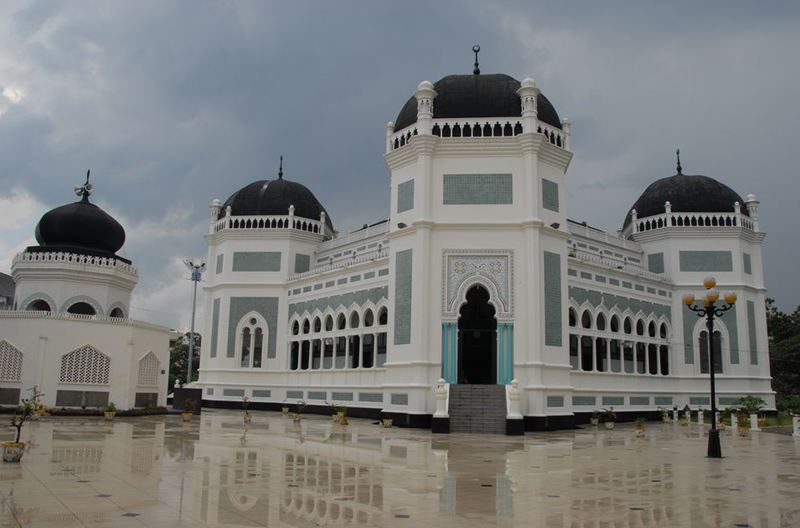
Great Mosque, Medan (Credit: Andre Vltchek)
|
The fatal weakness of the PKI emerged from its decision to take
the parliamentary road. It was not an irrational decision, given the vast
extent of the archipelagic country and its huge ethno-religious diversity, as
well as the Party’s commitment to ‘national integrity,’ and the menacing
proximity of America’s armadas and air power. But it meant that the Party was
mostly above ground, its members well known nationally and locally, and it had
no armed power of its own at all. The PKI attempted to substitute for this
weakness an increasingly harsh rhetoric, which did not add to its real power
and frightened its every-day enemies. Meantime, the anti- communist army
leadership increasingly backed, openly and surreptitiously, rightwing social,
political, religious, and intellectual organizations. Communism was banned
within its own ranks.
Origins of the Slaughter
Army leaders, helped by advice and half-concealed support from
both the Pentagon and the CIA – then reeling under heavy reverses in Vietnam –
had long been looking for a justification for a mass destruction of the Party.
Now the September 30th Movement and the murder of the six generals provided the
opening they awaited. Almost immediately the army-controlled media started a
lurid and successful campaign to convince the citizens that the Movement was
simply a tool, manipulated behind the scenes by the Party. By no means was it
an internal military mutiny. The communists were said to have been planning a
vast extension of the murders to the civilian population all over the country.
The army’s campaign began on October 3, when the bodies of three of the
generals were exhumed from a dry well in a remote part of the Air Force’s
Jakarta base. (They had not been killed at home, but kidnapped to this area and
then shot dead). The media, using blurred and retouched photos of the bodies,
claimed that the victims had had their eyes gouged out and their genitals
sliced off by sex-crazed communist women. (Many years later, thanks to military
carelessness, the post-mortems written up on October 3 by experienced forensic
doctors, and directed personally to Suharto that same day, came to light. No
missing eyeballs or genitals, just the lethal wounds caused by military guns.).
In a move that would have pleased Goebbels, the Movement’s full name was
deleted in favour of Gestapu (GErakan September TigA PUluh). No one noticed
that the word order here is impossible in the Indonesian language, but is
syntactically perfect in English. Very few Indonesian generals then had perfect
English). On top of the hyperinflation, this cunning Big Lie propaganda had the
desired effect: massive anti-communist hysteria.
The coolly-considered plan of Suharto and his henchmen for the
physical and organizational destruction of the Party was based on the huge
numbers of its members, affiliates, and supporters. To accomplish this mission
as rapidly as possible, army personnel were not enough; civilians had to be
involved on a large scale, with half concealed military direction, financing,
intelligence, transportation, and even supply of weapons. As secretive
corporate bodies notionally devoted to external defence against foreign
enemies, armies almost never boast about mass murder (see the mendacious
handling of the Rape of Nanking by the Japanese military and the near-genocide
of Armenians by the Turkish army). International scandal was to be avoided as
much as possible. National armies are not supposed to slaughter their
fellow-citizens, especially, as in the case of the PKI, if they are unarmed and
put up very little resistance.
Who were the primary collaborators? The two provinces with the highest
number of victims, Muslim East Java and Hindu ‘Paradise Island’ Bali are
exemplary. Both provinces were densely populated, ethnically quite homogeneous,
and with strong, conservative, traditionalist leaderships. The key thing to
bear in mind when we come to consider North Sumatra) is they were longstanding
strongholds of the two well-rooted legal, ‘national’ political parties, other
than the PKI, both with very large organizational and popular bases. In East
Java it was the traditionalist, orthodox Muslim Nahdlatul Ulama, with its
militant youthful-male affiliate Ansor. In Bali, it was the PNI (National
Party) led locally by landowners, Hindu priests, and members of the two upper
castes of Satrias and Brahmins. Small Catholic and Protestant parties with
their affiliates were also used in places where these religious minorities were
influential. (The large ‘modernist’ Muslim party, Masjumi, fiercely
anti-communist, was organizationally unavailable, since it been banned and
disbanded in 1959 for its role in the civil war of 1958-59, of which more
later).
These civilians were not professional killers. Once the massacres
were over, they ‘returned to ordinary life,’ while the military went on killing
large numbers of people in East Timor, Atjeh and Papua over the final two
decades of the Suharto dictatorship. Many of them, in an atmosphere of
media-generated hysteria, genuinely believed that “they will kill us if we
don't kill them first.” Needless to say, the military had no interest in
punishing any of those involved, but their immunity was also guaranteed in part
by the national institutions to which they were affiliated.
Aftermaths? During his brief presidency (October 1999-July 2001)
Abdurrrahman Wahid the charismatic, ‘progressive,’ and politically astute
Nahdlatul Ulama leader, decided to ask forgiveness from surviving
ex-communists. He did so, however, not for individual killers, but for Ansor in
particular and the NU in general. (No other national-level politician has
followed his example). More striking is the fact that over the past decade many
young members of Ansor, born well after 1965, began systematically to help
communists who had managed to survive the massacres and years and years of
brutal imprisonment. Fairly recently a reconciliation meeting was held in
Jogjakarta between NU and ex-communist women. Everything went well, until an
elderly communist described in detail how she had been raped and tortured by
Ansor members. As she spoke a young Muslim girl stood up, ashen-faced, and then
fainted. Among the rapists and torturers she recognized her own father. It is
interesting to note that, quite early on, stories circulated widely that
‘amateur’ killers had mental breakdowns, went mad, or were haunted by
terrifying dreams and fears of karmic retribution. Otherwise, silence. Nothing
to boast about in public or on TV, one might say.
Medan and North Sumatra:
Local History
Joshua’s Medan/North Sumatra was and is very different. The strange, dull name already tells one something. It simply means ‘field’ or ‘open space.’ It was the last major city begotten by Dutch colonialism -- beginning to rise only in the 1870s and 1880s, when the colonial authorities was realized that the surrounding fertile and near-empty flatlands were perfect for the development of large-scale agribusiness -- tobacco, rubber, palm-oil, and coffee plantations. One of the earliest oilfields in the colony was also discovered there just in time for the automotive revolution. The area was thinly inhabited by Malays, related to the Malays across the narrow Straits of Malacca in today’s Malaysia. In so far as there were any rulers at all, these were very small-scale and without much armed power, even if some called themselves ‘Sultan.’ For their own reasons, the Dutch protected these petty rulers and allowed them to share in the profits of the expanding economy; but the ‘Sultans’ had to do what they were told.
Medan was created in the era when the Dutch colonial regime
abandoned monopolistic mercantilism and adopted British-enforced economic
liberalism and open markets. Hence a motley crowd of investors -- Dutch,
British, German, Austrian, American, and eventually Chinese and Japanese –
poured in. From the start there was the huge problem of creating a submissive
labour force. The local Malays were too few and anyway not interested, and the
large numbers of young Chinese imported from Southeast China and
Malaya-Singapore soon proved too refractory and mobile to be long usable. The
answer came with the recruitment of indentured labourers from poverty-stricken,
overpopulated Java. It was a kind of modern slavery. Labourers were not only
pitilessly exploited, but had to sign contracts preventing them from quitting
and making sure that their ‘debts’ to the companies that transferred them to
Sumatra could rarely be repaid -- thanks largely to company stores. Thus, at
least until the onset of the Great Depression, Medan was a bit like a Gold Rush
town. One can watch the process by comparing the figures in the only two
censuses the colonial rulers ever held. 1920: 23,823 natives, 18,247 so-called
foreign orientals (Chinese, Arabs, Indians) 3,128 ‘Europeans’, who included
Japanese, for a total of 45,248. 1930: 41,270 natives, 31,021 Foreign
Orientals, and 4,293 ‘Europeans’, for a total of 76, 544. It was the only
significant Indies city in which the native population had only a tiny 53%
majority. (The 1930 total population was a bit smaller than the capital of
today’s Solomon Islands; meantime Medan has grown to over 2 million). From
Minangkabau West Sumatra, Atjeh, and Batak Tapanuli came traders, newspaper and
magazine publishers, reporters, ulamas, and Protestant small businessmen,
schoolteachers, preachers and low-level officials . Non-indentured Javanese
moved in too, serving as small and medium merchants, lawyers, newspapermen,
teachers, foremen, accountants, nationalist activists, and civil servants. The
Field was thus far more variegated than any other Indonesian city, including
even the capital Batavia (Jakarta today): Europeans of various kinds, Chinese,
Americans, Indians, Japanese, Arabs, Minangkabau, Bataks of many sorts,
Atjehnese, Javanese and so on. None formed a dominant majority. As a
consequence, religious variegation too: Protestant British, Dutch, Americans,
Germans and Toba Bataks, Catholic Dutch and Austrians, Confucian and Buddhist
Chinese, Hindu and Muslim Indians, strong Muslims like the Minangkabau and
Atjehnese, and syncretic Hindu-Islamic Javanese. But of course, there was
always a stable racial hierarchy, with Whites and ‘honorary-white’ Japanese at
the top, Chinese, Arabs and Indians in the middle, and natives mostly at the
bottom. The Field also was notorious for its Wild West social mores – gambling
and prostitution were widespread, and handled by mainly Chinese taukes and a mixed
ethnoracial rag- bag of thugs. (To get a nice picture of Medan at that time,
one can profitably read the final, confessional chapter of Mangaradja Onggang
Parlindungan’s weird masterpiece, Tuanku Rao). Opium was a state
monopoly.
In early 1942, the Japanese military, having disposed of the
British in Malaya and Singapore, took over the Dutch East Indies in a few
weeks.
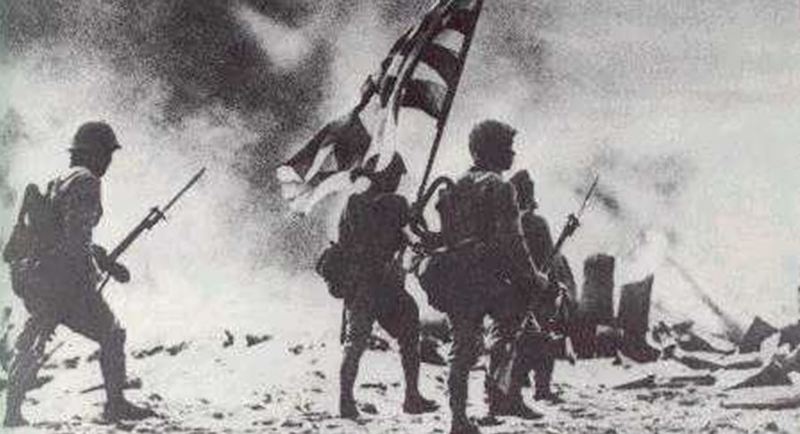
Japanese military
attack Rabaul, 1942
|
Sumatran and Bornean oil was the military’s main interest, but the
plantation economy also fell into hands. However, effective Allied bombing of
Japanese shipping soon made the export-oriented agribusiness economy collapse,
leaving in place only domestic demand and the military’s local needs. In North
Sumatra, the indenture system broke down to make way for smallholder producers
of foodstuffs like rice, vegetables, tea, and coffee, as well as castor oil. To
make this new wartime economy work the Japanese authorities opened the door to
‘illegal’ occupiers of agribusiness lands, including a huge wave of Protestant
Toba Bataks from the interior.
After the American atom-bombing of Hiroshima and Nagasaki, the
Japanese state surrendered unconditionally, but several months passed before
the British and Dutch could bring colonial military power back to the Indies,
and in this vacuum the Republic of Indonesia was born on August 17, 1945. In
the exhilarating, chaotic first year of the Revolution (1945-46), there were a
number of regions in Sumatra and Java which experienced vengeful revolutionary
onslaughts on ‘collaborators’ with Japanese and Dutch, semi-feudal local
aristocracies, abusive civil servants, and so on. The most chaotic and
bloodthirsty of these occurred -- unsurprisingly – in North Sumatra. The local
petty sultanates were overthrown with ease; many of the Malay ‘aristocrats’
were murdered and their wealth stolen or confiscated. Indonesia’s greatest
poet, Amir Hamzah, was among the victims. Toba Bataks, Atjehnese, Simalungun Bataks,
and Javanese seized Japanese or Dutch guns, and fought each other for the
spoils without being able to establish any coherent political order. The
Republic’s Socialist-dominated government was appalled by all this, knowing
that it would blacken the country’s name overseas, enrage colonial-era
investors wanting their properties back, and alienate possible diplomatic
allies. Gradually, with military help, some kind of order was established,
after which the Dutch succeeded in reoccupying Medan’s plantation belt. But not
for long.
In December 1949, after four years of intermittent war and
negotiations, the Netherlands signed over sovereignty of the old colony to a
‘Federal Republic of Indonesia,’ one of whose components was North Sumatra
(then still called East Sumatra), headed by surviving local aristocrats. But
within a year federalism disappeared, the aristocrats succumbed, and today’s
Unitary Republic was established. The central condition of this transfer of
sovereignty, insisted on by the rapacious Americans, was that all Dutch (and
British and American) pre-war properties be returned to their colonial-era
owners. The situation was particularly volatile in the surroundings of Medan.
Even in the last two decades of colonial rule, the field had become a hotbed of
anticolonial nationalism. This trend accelerated in the last year of Japanese
rule and after the Declaration of Independence. The radical language of
‘Revolution’ made a deep impression too, mostly for the good. But ‘Revolution’
also allowed hardened criminal elements to operate under its aegis, sometimes
with half-genuine revolutionary commitment.
North Sumatra was a natural zone for successful recruiting by a
reborn PKI,?which had been suppressed by the Dutch after the failed uprisings
of 1926-27 and later by the Japanese military. The single most militant
organization there in the 1950s was the Sarekat Buruh Perkebunan Indonesia, or
Sarbupri, a huge union for plantation labourers, whose mass base lay in the
once indentured Javanese labour force, combined with leadership mostly provided
by educated Javanese and Protestant Batak activists. It is useful to note that
the PKI Politburo, headed from 1951 on by D.N. Aidit, had real trouble with
Sarbupri’s militancy, since the party, having chosen to join the parliamentary
system (at the national and local levels) was worried by unauthorized local
revolutionary activities which could damage its cautious political strategy. A
number of Sarbupri leaders were demoted, kicked out, or disciplined. Sarbupri also
got political support from the smallholder migrants of the Japanese occupations
whom the returning white planters were eager to kick out or subdue. Strikes in
Tandjung Morawa, in the plantation belt, only 14 kilometers from Medan’s city
centre even brought down one of the early constitutional-era cabinets.
Medan proved a specially difficult city to handle from Jakarta
because there was no ‘traditional’ social order, to work with, and no ethnic,
party-political, or religious group in a dominant position. It also contained,
proportionately, the highest number of ‘foreign Asian’ inhabitants. Situated
close to Singapore, it was also notorious for its talented smugglers. In
addition, the fractious local military often created additional problems.
When the Revolution of 1945 broke out, the national army was
formed in a very unusual way. The core of its middle- and upper-echelon leaders
had been low- level NCOs and junior officers in Japanese-created auxiliary
forces trained to help the Imperial armies, if and when the Allies landed, in
local guerilla warfare, Since Sumatra and Java were controlled by different
Japanese armies not subordinated one to the other, the Peta in Java and the
much smaller Giyugun in Sumatra had no organic connection. Almost all recruits to
the new national army were in their 20s, no matter what posts they held, so
that it was usual for commanders to be chosen by their own men, rather than by
any higher authorities. In the 1950s therefore, the High Command in Jakarta had
great difficulties in controlling local, and locally popular, military
officers, who frequently refused to carry out orders and sometimes acted like
warlords. Medan was a striking case. The Protestant Toba Batak commander for
the seven years between 1950 and 1957 was Colonel Simbolon, who controlled
large scale smuggling operations through Medan’s port, and refused to be
transferred. But when he joined the anti-Jakarta coalition, which in February
1958 started the PRRI rebellion,1 he was quickly toppled by a counter-coalition
of the High Command, leftist local Javanese juniors, and the clique of his
successor, Lieut. Colonel Djamin Ginting, a Karo Batak who claimed to speak for
Karos oppressed by their distant Toba cousins. Once installed, Ginting turned
on the leftist Javanese officers. Many Islamic organizations, mostly controlled
by Minangkabau, who also supported the PRRI, were crippled by its defeat and
the ban on the Masjumi modernist Islamic party on the grounds of rebellion.
The other crucial development came from the mess created by
President Sukarno’s rash decision in December 1957 to nationalize all Dutch
enterprises in retaliation for The Hague’s constant refusal to settle
diplomatically the conflict over Western Papua, which was supposed to have been
solved early in the 1950s. Takeovers were initiated by unions affiliated with
the PKI’s secular rival, the PNI, but the communists quickly joined in. Not for
long. The Army High Command used its emergency powers to take control of all
the nationalized enterprises, claiming that they were vital assets for the
nation. For the first time in its history the military obtained vast economic
and financial resources, especially plantations, mines, trading companies,
utilities, banks, and so forth. Needless to say, strikes were forbidden in all
these sectors. Since these sectors, owned hitherto by foreigners, were those
where leftist and nationalist unions had had the greatest freedom, the military
had to develop an effective corporatist counterforce. In partial imitation of
the PKI’s SOBSI, a nationwide
federation of its affiliated unions, the army created SOKSI.
Its name indicated the intentions of its creators. K stood for karyawan, a
corporatist neologism for ‘functionary,’ aw its membership included everyone –
management, office staff and white-collar workers, as well as labour. One could
think of SOKSI as an agglomeration of ‘company’ unions. Thus the B in SOBSI,
standing for Buruh (labour), was to be eliminated.
In the Medan area, and in the face of SOBSI’s well-established presence,
the military needed substantial manpower outside its own active ranks to impose
its will on the huge plantation belt. It so happened that an instrument was at
hand. In 1952, the Army Chief of Staff, the Mandailing Batak A.H. Nasution, was
suspended for his role in a failed mini-coup in Jakarta. Still young and
ambitious, he decided to form an electoral organization of his own, which he
called IPKI, Ikatan Pendukung Kemerdekaan, or League of Supporters of
Indonesian Independence), described as a movement opposed to the existing major
parties, especially the PKI. In the 1955 elections, it won only four seats, but
it was evident that the strongest of its bases lay in Medan. In that year,
Nasution was reinstated as Army Chief of Staff by Prime Minister Burhanuddin
Harahap, scion of a clan of Southern Bataks (Angkola) well comnnected to the
Nasution clan -- but he kept control of IPKI. After the crushing of the PRRI,
but with Martial Law in solid place, IPKI developed a ‘youth wing,’ parallel to
those of the major legal parties, which came to be called Pemuda Pantjasila,
nominally composed of retired soldiers and civilian veterans of the Revolution.
The key figure in this Pemuda Pantjasila was another Mandailing Batak, a
serious Medan gangster and ex-boxer called Effendy Nasution. 2 These gangsters
had had their own clashes with the PKI youth organization, Pemuda Rakjat, over
‘turf’ as well as ideology, and were ferociously anti-Communist. But as members
of a ‘national organization,’ sponsored by the top Army officer, they had
excellent protection, also for their protection rackets. Over the six years
between 1959 and 1965 the military and the Medan gangsters collaborated more
and more closely with each other. The PP significantly helped SOKSI to control the
plantation belt against formidable SOBSI/Sarbupri resistance. Thus when Suharto
decided to inaugurate the massacre of communists, the Medan underworld, dressed
up as Pemuda Pantjasila, was ready to ‘help’ and accustomed to carry out
‘confidential’ Army directives.
The contrast with the huge Javanese plantation belt is striking.
We have seen how in this zone the army could rely on the Nahdlatul Ulama’s
huge, and legal, mass- organizations, as well as the authority of the mainly
Javanese territorial civilian bureaucracy, manned heavily by conservative
elements in the PNI. In Medan, the NU presence was minimal, the PNI was
factionalized, while the once-powerful modernist Muslim party Masjumi had been
banned in 1959. No united civil bureaucracy existed in such an ethnically
complex melting pot. This is why, when the massacres drew to an end, NU and
Ansor members in Java generally returned to ‘normal’ religious life (and soon
came into conflict with the military), while Medan’s gangsters returned to
another ‘normal life,’ of extortion, blackmail, ‘protection,’ gambling dens,
brothels and so on, while staying close to the military. But with new patrons,
as time passed. General Nasution, now retired, gradually faded away.
Eventually, in 1980, the PP’s leadership went to Yapto Soerjosoemarno, the
Eurasian son of a Surakartan aristocrat and general, and a Jewish-Dutch mother.
Yapto, ice-cold mercenary killer, and big-game hunter had long been close to
the Medan gangsters, but was also a relative of Mrs. Suharto. Officially, PP
was an independent organization, but it always supported Suharto and his
policies, and helped to enforce the steady series of electoral victories by
Golkar, the regime’s nonparty party-of-the-regime. It remained loyal to its
patron right up to his abdication. (Since then, it has found no steady patron,
and its power and unity have visibly declined). Meantime, the NU, a national
party, tried its best to compete with Golkar in elections, and for a time was
the most significant component of the impotent legal opposition.
Petrus
It is
instructive to note what happened when Suharto decided, in 1983, to liquidate
substantial numbers of petty gangsters. (In the press the killers were
initially termed penembak-penembak misterieus i.e. mysterious shooters, quickly and
sardonically given the acronym Petrus, i.e. Saint Peter, since the operational
mastermind was Catholic, Eurasian Lieutenant-General Benny Murdani). In Java
several thousands were brutally murdered, in the dead of night, by Army
commandos in mufti. In Medan their opposite numbers went untouched. The reason
for the difference is clear. In 1980, Central Java was unexpectedly rocked by a
coordinated wave of violence against local Chinese, in which petty gangsters
played a visible role. Many of these people had worked as electoral enforcers
for Suharto’s éminence grise,
Major-General Ali Murtopo, who also headed Suharto’s private political
intelligence apparatus (Opsus). For an always-suspicious tyrant, it looked as
if his once-trusted accomplice might be flexing his own political muscles, to
show what his shady apparatus might do before and during the next elections.
The unexpected and unauthorized anti-Chinese violence hit Suharto’s nerves in
another way. 20th century Java had a long history of popular Sinophobic
movements, which could spread alarmingly fast if the circumstances were
suitable. Furthermore, the successes of Suharto’s New Order ‘development’
economy depended heavily on the energies of the country’s Chinese, whose safety
and prosperity were excellent signs of stability in the eyes of foreign
investors. Thus the liquidation of Murtopo’s gangster network can be understood
both as reassurance to the Chinese, and as depriving Murtopo himself of any
independent political power. Not long afterward, he was exiled as Ambassador in
Kuala Lumpur where he succumbed to a heart attack. Nothing like this happened
in distant Medan, since the gangsters were reliable allies of the local
military, not dangerous minions of a key figure in Suharto’s own Jakarta
entourage. If, as periodically happened, they were behind anti-Chinese
violence, the main motive was not Sinophobia, but a raising of the level of
protection payments .3 It is instructive, one may note in passing, that in his
bizarre semi-ghosted memoir, Otobiografi: Pikiran, Ucapan dan
Tindakan Saya (Autobiography:
My Thoughts, Statements and Actions) Suharto boastfully took responsibility for
these extrajudicial killings, in the following dishonest manner: “The real
problem is that these events [Petrus] were preceded by fear and anxiety among
the people. Threats from criminals, murders, and so on all happened. Stability
was shaken. It was as though the country no longer had any stability. There was
only fear. Criminals went beyond human limits. They not only broke the law, but
they stepped beyond the limits of humanity. For instance, old people were
robbed of whatever they had and were then killed. Isn’t that inhumane? If you
are going to take something, well, take it, but don’t murder. There were women
whose wealth was stolen and other people’s wives were even raped by these
criminals and in front of their husbands. Isn’t that going too far? Doesn’t
that demand action? [...] Naturally, we had to give them the treatment [original in English], strong
measures. And what sort of measures? Yes, with real firmness. But that firmness
did not mean shooting, bang! Bang! Just like that.. But those who resisted,
yes, like it or not, had to be shot....... So the corpses were left where they were,
just like that. This was for shock therapy [original in English] so the masses
would understand that, faced with criminals, there were still some people who
would act and would control them.” But the dictator never boasted about his
masterminding the massacres of 1965.
With
this comparative background in mind, it becomes easier to understand the
peculiar impunity exhibited by Joshua’s collaborators. They had been
professional criminals all their adult lives, and if some of the leaders had
political ambitions these were essentially local or provincial, aiming no
higher than the governorship of North Sumatra, and far removed from
Jakarta. In power, they pursued traditional gangsters’ interests, money,
respect (fear), immunity from the law, and some political positions. They were
not associated with any nationally-important political or religious
organizations beyond Suharto’s own Golkar, which they served obediently. They
had worked with the military from well before the massacres, and carried out
the killings of communists with savage efficiency. They did not organize
serious Sinophobic violence after 1966, nor did they put the squeeze on local
foreign investors. One could say that, in an odd way, they even regarded
themselves as a sort of half-hidden left hand of the New Order Leviathan:
uncivil servants.4 Best of all, when Suharto turned on gangsters in Java, the
‘boys’ were left untouched. Not surprisingly, there was no question of
Abdurrahman Wahid’s plea for forgiveness.
Nonetheless,
we can surmise that they had their disappointments. One of these must have been
lack of official and national recognition for their role in the massacres, the
one moment in their otherwise humdrum criminal lives where they could imagine
themselves as among the saviors of their country. The problem lay with
‘Jakarta,’ and the stance that Suharto and his henchmen took with regard to the
slaughter. The striking thing was that these ruling circles handled the annual
commemorations for 1965 by largely concentrating on October l’s first victims
-- as national heroes. Every town had streets named after these generals, and
in Jakarta a special museum was created in their heroic honour. A
state-sponsored film – for which annual viewings were compulsory in all schools
and colleges – consisted entirely of mourning for the generals, and execration
of the diabolical PKI. But in Medan, no general, or indeed any military
officer, had been killed.
Furthermore,
the basic official account of the last three months of 1965 depended on a
rhetoric of popular fury at PKI bestiality. American journalists at the time
liked to explain, in colonial-speak, that the primitive population had gone amok. The military’s propagandists employed
this idea, describing the Army’s role as curbing and calming down this wave of
‘spontaneous’ popular violence. (In fact, there is overwhelming evidence that
the massacres in Central Java started with the arrival of the red-beret
commandos in mid-October, and in East Java one month later when these
professional killers moved east.)
There
were, thus, no heroic slaughterers honored by the Suharto regime. The most
notorious red-beret officers never made it up to the top levels of the
military. Finally, the euphemistic official language of the regime precluded
heroism. Thus communists arrested by the military, then executed or imprisoned
for years without trial, were said to have been di-amankan,
which can be translated as ‘secured,’ for the sake of keamanan or ‘public’ security. In later years,
when generals got the itch to write their memoirs, they used the same
euphemisms. They had ‘secured’ communists, not least to protect them from ‘the
anger of the people.’ The regime never boasted about the massacres and never
announced any figures of the number who had died. This entire propaganda
strategy, also aimed at foreign audiences, left no place for ‘heroic killers’
in Medan’s imagery. But hadn’t the gangsters helped to save the country? So,
willy-nilly, they set up their own monument to themselves, a 30 foot high
chrome ‘66’ next to the city’s railway station. An ignorant traveller could
take it for a logo for some new fast-food competitor for McDonalds.
Furthermore,
had these old timers been adequately rewarded in practical terms? If one looks
at the two killers featured in Sungai Ular, one can see
that they are actually nobodies. Elderly men, with decaying muscles and petty
bourgeois clothes and homes, few visible signs of prestige, no medals, only
local fear. To be sure, the top gangsters have acquired splashy mansions,
luxurious cars, expensive kitschy jewelry and wristwatches, and some important
but local official posts. But these emoluments were not, primarily, immediate
rewards for yesterday’s ‘heroism,’ nor were they much then publicized, but
rather evolved incrementally over mundane decades of dictatorship and
criminality. They are not ‘in national history,’ in a country where national
history is very important, and national heroes abundant.
This
condition helps to explain some of the peculiarities of the figures we can see in
Joshua’s films. His camera offers them the possibility of commemoration, and
transcendence of age, routine, and death. When the more ghastly of the two
killers in Sungai Ular is shown in his petty bourgeois home
with his wife and family, he is renarrating some of the most terrible tortures
and murders that he inflicted. The family is used to this endless domestic
reenactment. His plump wife giggles to keep him happy, and the children pay no
attention at all. He boasts of his magical powers, saying that the widows of
communists come to him for healing. True? Maybe, but their arrival at his house
is merely a sign that forty years later they are still afraid of him. His
invisible medal is this abiding terror. A kind of dim hierarchy is still
visible, when the two veterans have to decide who will play communist and who
killer.
They
have a commemorative idea about film, actually Hollywood films which they loved
from their teens. The Lone Ranger, Batman, Patten, Shane, Samson, MacArthur,
Rambo, et al – all real or imaginary men -- are figures of immortality for
killers who are heroic patriots, not grand gangsters. This doesn’t mean that
they don’t live within local cultures – supernaturalism, Gothic horror comics,
kitschy melodrama. Joshua thus comes to them as a kind of providential
‘Hollywood’ ally. They will die soon, but maybe he will make them immortal.
Yet
they are stuck. They do not have available to them anything that can represent
the communists. While Suharto was still dictator, his regime could issue must-watch
films showing the bestiality of the PKI, and mourning the murdered generals.
But such films have gone out of circulation since his fall 12 years go. The
‘Medan boys’ have nothing like this, and local history of events 45 years ago
is gradually headed for oblivion or myth. So some of them have to act the
communists themselves, sometimes even in drag . As nationalist gangsters, they
have no place in a national history into which the Indonesian Army as a
corporate institution with an ‘honorable’ patriotic record can be inserted.
Their gangsterism is filmable only in terms of costume, body- language, and
kitschy imaginative success. (This attitude resembles the outlook of American
Cosa Nostra people, who, journalists report , love going to gangster movies and
identify with the FBI!)
At the
same time, these old men realize that they are also within a market of
industrial fantasies, access to which comes through the American, who is young
enough to be their son. This is a market, which, over the years, has
increasingly blurred the boundaries between the established genres of heroic
war films, gangster films, and horror films, at the expense of the former and
to the advantage of the latter. (Shining Shane gives way to cannibal Hannibal
Lecter. This condition makes it imaginable to have Apocalypse Now replace
Bataan.) But it allows for fantasies not available in 1965. We can take Anwar
Kongo as exemplary. He proudly shows himself as a sadistic murderer, but .....
he is haunted, so he enacts, by the ghosts of his victims; but then he
congratulates himself on helping to send his prey straight to Heaven, as if in
a ‘black mass’ retroversion of jihad theology. He shows his weird authority by
forcing (???) his favorite large, overweight, thuggish henchman Herman to dress
up as a Communist woman. ‘She’ appears with the depressing glitzy outfit of a
well-off, middle-aged transvestite in a TV competition. A real Communist woman,
a gaunt, shriveled, terrified widow in her 70s would never do. Actually there
are no limits (let’s see what we can do!) except that only he and his boys can
appear in the film. There is a kind of despair at work.
This
despair is actuated by Joshua. The gangsters reenact whatever they wish and can
imagine, but they can not control what “their” film will be like in the end.
Joshua is a conundrum. He is there, like Rouch, beyond the camera’s reach, an
unseen interrogator, pal, witness, kid, judge, motherfucker. They have no idea
how to control him, because they are his actors and there is no final script
that they master. He is not part of their film but they are part of his. There
are no famous Hollywood films with invisible characters interrogating Joshua’s
in them. This is a source of anxiety. (Joshua has written to me that while many
of these people trust him almost completely, others are becoming suspicious
that he may be betraying them)
The
inevitable response is a strange mixture of motivations. Excess first: “Beat
this, motherfucker! I sent them all to Heaven and they should grateful to me.”
Second: recourse to the filmic supernatural. “That bastard Ramli was so
magically invulnerable that it took us ages to kill him, and we had to cut off
his dick first!” Third: pride. Today, forty-five years after 1965, “ they are
still terrified of us.” Fourth: hope. “We’ll be famous around the world, even
after we die, no matter if young Indonesians don’t want to think about us, and
the government will never give us the monuments we deserve.” Fifth:
Truthfulness. “There was no amok, and we loyally
carried out the instructions of the national army.” Last: the smugness of
impunity. “Kid, we can reenact anything at all, and there is nothing anyone,
including you, can do to us.” All the same, they are, like everyone else, under
sentence of death from the day they are born. They know they will soon be
buried, and nobody will give a damn. There is no one who can send them straight
to Heaven.
Benedict
Anderson is the author of Imagined Communities. Reflections on
the Origins and Spread of Nationalism and an authority on Indonesian politics and
culture. He is professor emeritus of Government at Cornell and an editor of New
Left Review.
This
article is adapted with a new introduction to a chapter in, Killer Images: Documentary Film,
Memory and the Performance of Violence,
edited by Joram Ten Brink and Joshua
Oppenheimer. Copyright © 2013 Joram Ten Brink and Joshua Oppenheimer.
Reprinted with permission of Columbia University Press.
Recommended
Citation: Benedict Anderson, "Impunity and Reenactment: Reflections on the
1965 Massacre in Indonesia and its Legacy," The Asia-Pacific Journal, Vol.
11, Issue 15, No. 4, April 15, 2013.
Benedict
Anderson’s published work on the Indonesian coup of 1965 spans the years
1966-2012 and includes the following:
1.
1966. Benedict R. Anderson, Ruth McVey, and Frederick P. Bunnell,A preliminary analysis of the
October l, 1965 coup in Indonesia(Ithaca: Cornell Modern Indonesia
Project.
2.
1972.Java in a time of
revolution(Ithaca: Cornell University Press).
3.
1983.Imagined Communities,
Reflections on the Origins and Spread of Nationalism(London: Verso)
4. 1985.In the mirror: literature and
politics in Siam in the American Period(Bangkok: Duang Kamol)
5.1990.Language and Power, Exploring
Political Cultures in Indonesia
(Ithaca:
Cornell University Press)
6.
1998. The spectre of comparisons: Nationalism, SE Asia, and
the World(London: Verso)
7.
2005.Under three flags:
anarchism and the anti-colonial imagination(London: Verso).
8.
2008.Why counting counts:
a study of forms of consciousness and problems of language in Noli Me Tangere
and El Filibusterismo(Manila: Ateneo de Manila Press)
9.
2012.The fate of rural
hell: asceticism and desire in Buddhist Thailand(Calcutta: Seagull
Press).
Notes
1 The PRRI (Revolutionary Government of the
Republic of Indonesia) was announced after Jakarta rejected an ultimatum
demanding Sukarno’s return to being merely a symbolic head of state, the
formation of an anti-communist extra-parliamentary cabinet, etc. It was
substantially aided, financially and militarily, by the CIA. Its stronghold was
Sumatra, and its core leadership came from well-entrenched ‘native son’
officers, though various prominent leaders of parties (mainly Masjumi) were
included to give the PRRI a better international reception. Not long afterward,
a comparable movement appeared in Sulawesi, which allied itself with the PRRI.
It should be added that regional discontent with Jakarta’s policies and growing
insubordination among Outer Island commanders had forced the central government
to declare martial law for the whole country in March 1957. This declaration
can be said to mark the start of the military’s eventual domination of the
country over most of the next forty years.
2 Among Batak purists, the Nasution clan was
often suspected of mixed blood impurity, i.e. mix of Batak, Minangkabau,
Indian, Atjehnese and Arab. This may explain why Effendy’s street title was
Effendy Keling (Indian). It is also possible that he was not born into the
Nasution clan, but was adopted into it.
3 In late colonial times,
the most feared urban gangsters in the Indies were Eurasian and Chinese, i.e.
from marginalized social groups. During the Revolution, some of the Eurasians
took the side of the Dutch, while Chinese gangsters were recruited into the Po
An Tui, a pro-Dutch force which tried to protect Chinese from Sinophobic
violence In the 1950s, over 200,000 Eurasians fled to The Netherlands,
willingly or unwillingly. Still, as we have seen above, the two most feared killers
under Suharto, Murdani and Yapto, were both Eurasians. Chinese gangsters still
existed, but Baperki, the dominant political organization for Chinese
Indonesians was, under the capable leadership of leftwinger Sjauw Giok Tjhan,
mindful of the bad reputation of the Po An Tui, so that it did not have a
serious gangster element. After October l. 1965, many Baperki members were
killed, tortured, and imprisoned, and the organization was banned as
‘communist’. Hence, ‘on the streets’ Chinese had no organized protection bodies
of their own. This situation opened the way for their fellow ‘foreign Asian’
business rivals, especially, in Medan, ‘Indians’ and Arabs’ of various kinds,
to take over. If one looks at Joshua’s list of the names of PP leaders and backdoor
masterminds, one will be struck by the number of them who are, wholly or
partially, of Punjabi, ‘Afghani,’ and Arab stock. All Muslims, of course.
4 In the middle 1980’s I was
contacted by a lady lawyer in Germany, asking me to provide professional
testimony for a youngish Indonesian pleading for sanctuary. In written
correspondence, the man said he had fled to Germany on the advice and with the
help of his father, a middle ranking officer in the Army’s military police. He
had been a member of a gang, mostly sons of military men, which made its living
by ‘guarding’ bars, discos, nightclubs. The gang strongly supported the Suharto
government and help to make every election a ‘success.’ Then, out of the blue,
came Petrus and he had to run for his life. I told him that since Petrus was
aimed solely at gangsters, and this was widely known, the only way to get the
German court to believe that they should grant him sanctuary was to admit that
he was a gangster. The curious thing is that he could not bring himself to do
so, insisting that he had always been loyal to the regime, and where required
carried out its policies. This is a perfect example of left-hand bureaucratic
consciousness. What, me?
(The Asia-Pacific Journal, Vol. 11, Issue 15, No. 4, April 15, 2013)
We welcome your comments on this and all other articles.


 JUMAT, 1 Maret 2013. Patung dan Rumah Sejarah Jendral Soeharto diresmikan di desa Kemusuk, Bantul, Yogyakarta, tanah kelahirannya. Dengan senyum lebar, putri sulungnya, Tutut Soeharto, membuka selubung patung berbaju militer setinggi 3,5 meter. Para tetamu, di antaranya menteri – menteri zaman Orde Baru, bertepuk tangan penuh haru.

